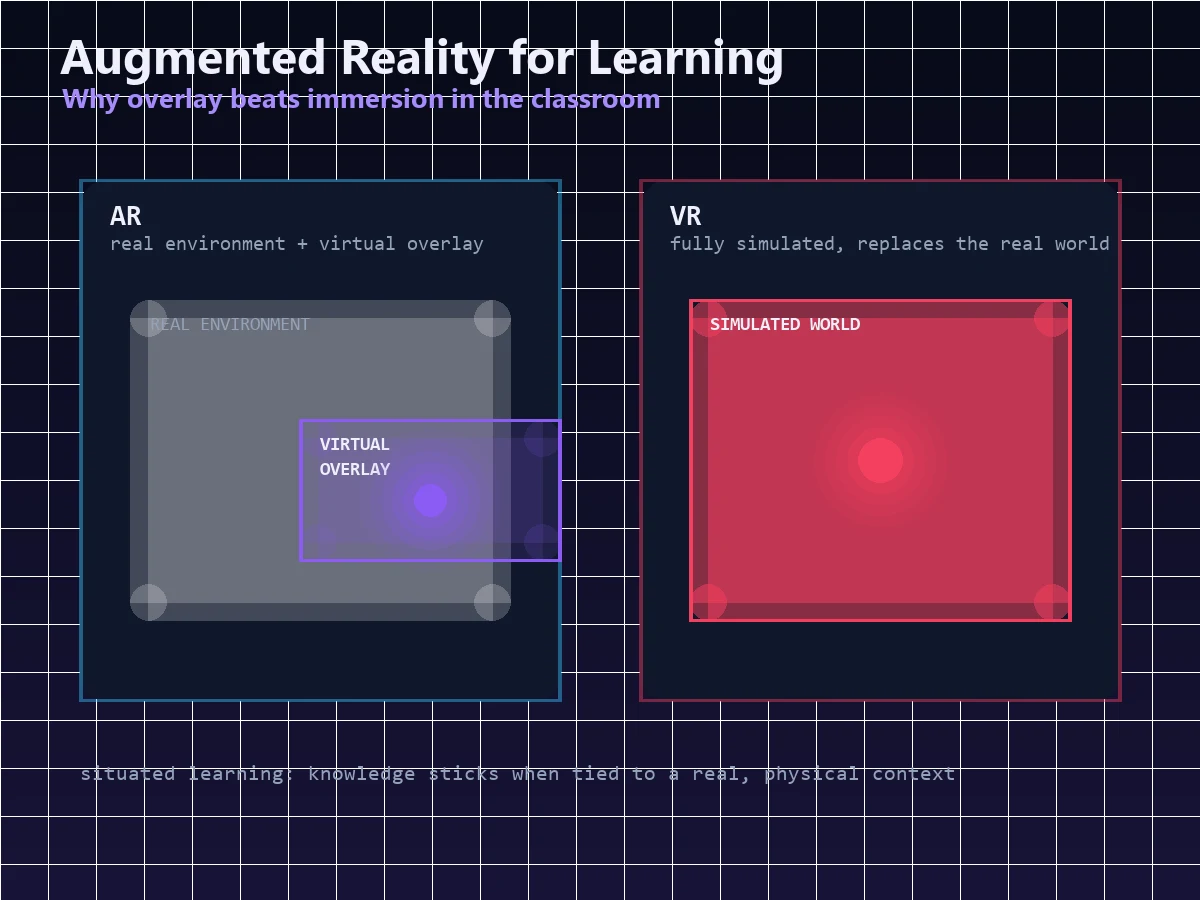
Hand a 3rd-grader a VR headset and you've removed them from the classroom. Hand them a tablet running an AR app and you've added something to the classroom they're still standing in. That distinction — subtraction versus addition — turned out to be the entire pedagogical argument behind my third-semester M.Tech seminar on Augmented Reality in education, built around a review of Rossano and Lanzilotti's research on Geo+, an AR app for teaching solid geometry to primary school pupils. This post covers the theory; part two covers how the app was actually built, and part three covers whether it worked.
The learning theory underneath the technology
The pedagogical foundation traces back to Piaget's constructivist theory: people acquire knowledge more effectively through genuine experience, when that knowledge is anchored to a real, specific context, rather than delivered as abstract fact. AR's relevance follows directly — it enables situated learning, where understanding forms because it's embedded in a physical environment the learner can see and touch, not despite being disconnected from one.
That's a sharper claim than "technology is engaging." A worksheet with a QR code that plays a video is technology in the classroom, but it isn't situated — the content still floats free of physical context. AR's specific promise is that the 3D pyramid a child is examining is, visually, sitting on their actual desk.
Defining the terms precisely
Augmented reality, by the definition this seminar worked from, must satisfy three properties simultaneously: a combination of real and virtual worlds, real-time interaction, and accurate 3D registration — the virtual object has to convincingly occupy real space, tracked and updated as the world (or the camera) moves. The overlay can be constructive, adding to the natural environment, or destructive, masking part of it — either way, the real environment stays the foundation, with virtual content layered on top.
Virtual reality takes the opposite approach: it replaces the user's real-world environment with a simulated one entirely, typically through a headset that blocks out the physical room. Both technologies sit under the broader umbrella of "extended reality" (XR) alongside mixed reality, but the pedagogical fork happens right here — AR keeps the classroom, the desk, and the other kids in the picture; VR removes all three.
For adult training — flight simulators, surgical rehearsal — full immersion is often exactly the point: you want the trainee to forget the real room. For a classroom of eight-year-olds, that's close to the opposite of what a teacher needs. AR lets an app enrich a lesson a teacher is still actively running, instead of replacing the teacher with a headset.
AR's track record beyond geometry
The literature this seminar surveyed shows AR reaching well past STEM subjects. TeachAR used a desktop AR setup with Microsoft Kinect for speech recognition to teach basic English vocabulary — colors, shapes, prepositions — to non-native-speaking children, with physical markers changing the shapes and colors on screen; a comparison against a plain mouse-based interface showed AR winning on both subjective engagement and post-test scores. HELLO (Handheld English Language Learning Organization) extended similar ideas to handheld devices. Outside language learning, the Eco MOBILE project used a mobile app to overlay virtual data on a physical pond, having students navigate the real environment and collect simulated water-quality measurements — situated learning applied to environmental science instead of vocabulary.
What earlier geometry-specific AR tools got right — and missed
Closer to Geo+'s own territory, several AR tools targeted geometry directly. One used plain 2D figures as physical markers to trigger 3D solid models on a smartphone, displaying area and volume formulas on tap. AR Geo, aimed at middle schoolers, built three structured exercise types — recognizing regular solids, retrieving related formulas, identifying cut sections — gated so correct answers unlocked further content; compared against an equivalent web-based tool, the AR version won clearly on engagement (attention, relevance, confidence, satisfaction). Notably, the one dimension AR did not outperform the web version on was confidence — a reminder that "more engaging" and "more reassuring" aren't the same outcome, and a well-designed research study reports the metric that didn't move, not just the ones that did.
AR Geometry Tutorial System, also for middle schoolers, used virtual buttons to let students rotate and explore shapes from different angles, and measurably improved 3D thinking ability — the skill of mentally manipulating solid shapes. But when researchers dug into which sub-skills improved, the gains were uneven: the ability to structure 3D arrays of cubes and compute volume or area showed only limited improvement. AR moved the needle on spatial intuition more than on calculation — a genuinely useful finding for anyone designing the next tool, since it tells you which skill AR is actually good at reinforcing.
Why Geo+ targeted younger children specifically
Most of the AR geometry tools surveyed addressed older students, on the reasonable assumption that AR technology would be too difficult for young children to use and understand. Geo+ made the opposite bet, aiming at 3rd- and 4th-grade primary pupils — and building its content in direct collaboration with primary school teachers rather than assuming what a general geometry curriculum should cover. The hypothesis worth testing was almost the inverse of the usual caution: that AR's sense of the fantastical — the "wow factor" of a shape appearing to float on your actual desk — might work especially well on children young enough to still find that genuinely magical, provided the interface itself stayed simple enough for small hands and short attention spans.
Common pitfalls
- Treating "immersive" as always better. VR's full immersion is a feature for flight simulators and a liability for a classroom that still needs a teacher, other students, and a physical desk in the loop.
- Confusing engagement with confidence. AR Geo's own results show these can diverge — a tool can be more fun and motivating without making students feel more sure of their answers.
- Assuming AR improves every sub-skill equally. The 3D-thinking research found real gains in spatial intuition but limited transfer to calculation tasks — match the tool to the specific skill you're targeting.
- Skipping teacher collaboration. Geo+'s content was built with primary teachers, not assumed from a generic curriculum — a detail easy to skip and expensive to skip badly.
- Assuming AR is too complex for young children. That assumption steered most prior tools toward older students; Geo+ deliberately tested whether it actually held for 3rd-graders.
FAQ
Did you build an AR application yourself for this seminar?
Is AR generally proven to improve learning outcomes?
Why does 3D registration matter so much for AR?
Could this same logic apply to training adults, not just children?
Interested in EdTech, interactive web applications, or a full-stack build in Dubai, UAE? Get in touch.

About the author
Ashiq S is a Full Stack Developer based in Dubai, working with Laravel, PHP, WordPress, WooCommerce, APIs, Docker and Linux. See his projects and experience. Hiring? See freelance Laravel development or full-stack roles in the UAE.