Every RFID tag that skips encryption to save cost is a tag that can be cloned or eavesdropped for free. For my first-semester M.Tech seminar, I reviewed the research on lightweight cryptography for RFID tags — a corner of security engineering most web developers never touch, where the constraint isn't clock cycles or memory, it's literally the number of logic gates you're allowed to burn. This post is what that seminar covered: why full-strength ciphers don't fit, and how the Piccolo block cipher earns its keep in under 700 gates.
The tightest budget in computing
An RFID tag in the mode this seminar focused on is passive: it has no battery. A reader's antenna emits an electromagnetic field, the tag's own antenna harvests just enough of that field to power its chip for the fraction of a second it takes to reply. Every logic gate on that chip draws current from a power budget measured in microwatts, and every gate costs die area, which costs money at the volumes RFID ships in — pallets, cartons, retail tags, transit cards.
Standard AES, the cipher securing your HTTPS connection right now, needs several thousand gate-equivalents (GE) to implement — completely reasonable for a smartphone, wildly over budget for a five-cent tag. That gap is the entire reason lightweight cryptography exists as a research field: designing ciphers that are deliberately weaker in generality — smaller block sizes, simpler key schedules, fewer rounds — in exchange for fitting a budget standard crypto never has to think about.
The landscape: more ciphers than winners
The literature surveys a genuine menagerie of lightweight designs, organized by type:
- Lightweight block ciphers — KLEIN, SEA, PRESENT, LBlock, and others, with PRESENT the most widely adopted in practice.
- Stream ciphers — Salsa20, WG-7, and A2U2 are the ones flagged as RFID-suitable, built around initialization and key-stream generation rather than block processing.
- Hash-based constructions — DM-PRESENT-80 stood out here, built by turning the PRESENT block cipher into a hash via a Davies-Meyer construction.
- Lightweight asymmetric (public-key) cryptography — the least mature of the four. Public-key math is inherently heavier than symmetric ciphers, and the lightweight variants that exist trade away security margin to compensate — which is exactly the property you don't want to compromise on.
The honest takeaway from surveying this space: there are a lot of lightweight ciphers, but far fewer that are both genuinely lightweight and hold up under serious cryptanalysis. That scarcity is what makes a well-analyzed design like Piccolo worth a closer look.
Piccolo: a cipher engineered to disappear
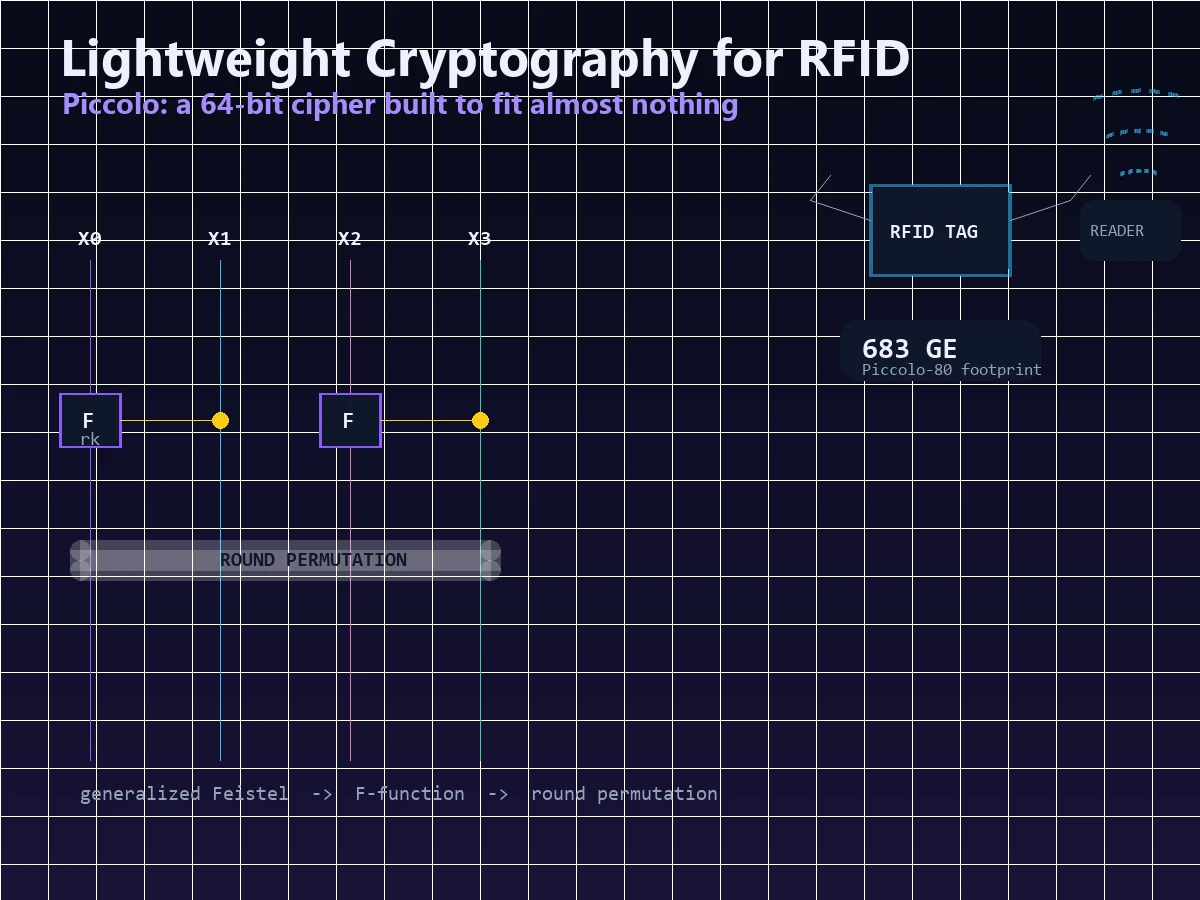
Piccolo (Shibutani, Isobe, Hiwatari, Mitsuda, Akishita, and Shirai — presented at CHES 2011) is a 64-bit block cipher built on a generalized Feistel network, and its headline number is its footprint: 683 gate-equivalents for Piccolo-80 (80-bit key, 25 rounds) and 758 GE for Piccolo-128 (128-bit key, 31 rounds). For comparison, a fully-featured AES implementation typically needs several times that.
X (64 bits) → split into 4 branches of 16 bits each
   branch 0 ──┐
   branch 1 ──┼── F-function ⊕ round key ── RoundPermutation ── (repeat r times)
   branch 2 ──┤
   branch 3 ──┘
Three design choices do most of the work of shrinking that footprint:
- A generalized Feistel structure with four 16-bit branches, rather than the wider datapaths standard block ciphers use — smaller branches mean smaller logic per round.
- A compact F-function: SubNibble → MixColumn → SubNibble. Nibble-sized (4-bit) S-boxes are dramatically cheaper in silicon than the byte-sized (8-bit) S-boxes AES uses, at the cost of needing more rounds to achieve equivalent diffusion.
- A permutation-based key schedule. Instead of computing round keys through an expensive expansion function, Piccolo derives them by XORing the master key against fixed constants and permuting halves of the block. Key scheduling is very often the expensive part of a lightweight cipher; Piccolo mostly reuses hardware it already has.
The RoundPermutation function is the other half of the design's cleverness: it slices the 64-bit block into eight bytes and shuffles them via a fixed permutation — cheap to wire in hardware, and enough to spread influence across the whole block over successive rounds without a heavyweight diffusion layer.
Why "lightweight" and "secure" pull against each other
Every gate you remove is a gate an attacker's analysis doesn't have to work around. Smaller S-boxes are less non-linear; fewer rounds mean less accumulated diffusion; a cheap key schedule can correlate round keys in ways an expensive one wouldn't. Piccolo's authors spent real design effort proving the cipher resists the standard mathematical attacks — differential and linear cryptanalysis — despite the corners cut for gate count.
But mathematical strength against a mathematician with pen and paper isn't the whole security story for a physical chip. A tag doesn't just compute a cipher — it draws power while it does, and that power draw is a side channel with its own attack literature, entirely separate from the block-cipher math. That's the subject of part two — how an attacker with an oscilloscope, not a mathematical breakthrough, can pull the key straight out of an unprotected implementation, and the countermeasure that closes that gap.
Common pitfalls
- Judging a lightweight cipher by key size alone. Piccolo-80's 80-bit key is smaller than AES's 128-bit minimum, but comparing key size in isolation ignores round count, S-box design, and diffusion — the whole system determines the real security margin.
- Assuming smaller always means weaker. Piccolo's designers spent real analysis proving resistance to standard cryptanalysis at its size; an un-analyzed small cipher is a very different risk than a deliberately engineered one.
- Treating gate count as the only cost. Latency matters too — Piccolo trades area for more clock cycles per block (432 for Piccolo-80), which is a fine trade for a tag that replies once, a poor one for something needing sustained throughput.
- Forgetting the key schedule's footprint. A round function can be tiny while the key schedule quietly eats the gate budget; Piccolo's permutation-based schedule was explicitly designed to avoid that trap.
- Stopping at "the math is secure." As part two covers, mathematical security and physical security are different guarantees — a cipher can be unbroken on paper and still leak its key through the chip's power pins.
FAQ
Did you implement Piccolo yourself, on real hardware?
Is Piccolo actually used in commercial RFID tags?
How small can a "lightweight" cipher get?
Isn't a smaller key just easier to brute-force?
Interested in embedded security, IoT, or a full-stack build in Dubai, UAE? Get in touch.

About the author
Ashiq S is a Full Stack Developer based in Dubai, working with Laravel, PHP, WordPress, WooCommerce, APIs, Docker and Linux. See his projects and experience. Hiring? See freelance Laravel development or full-stack roles in the UAE.